
AI-native assessment & credentialing
Know who's truly ready.
AI-powered interviews that produce structured, defensible evidence of mastery.
VeraCredentials, built by VeraLearning, uses adaptive AI interviews to reveal how people think and solve problems in authentic, real-world contexts. Beyond test scores, you gain clear insight into judgment, decision-making, and applied skills. These signals distinguish genuine readiness and understanding from test-taking ability.
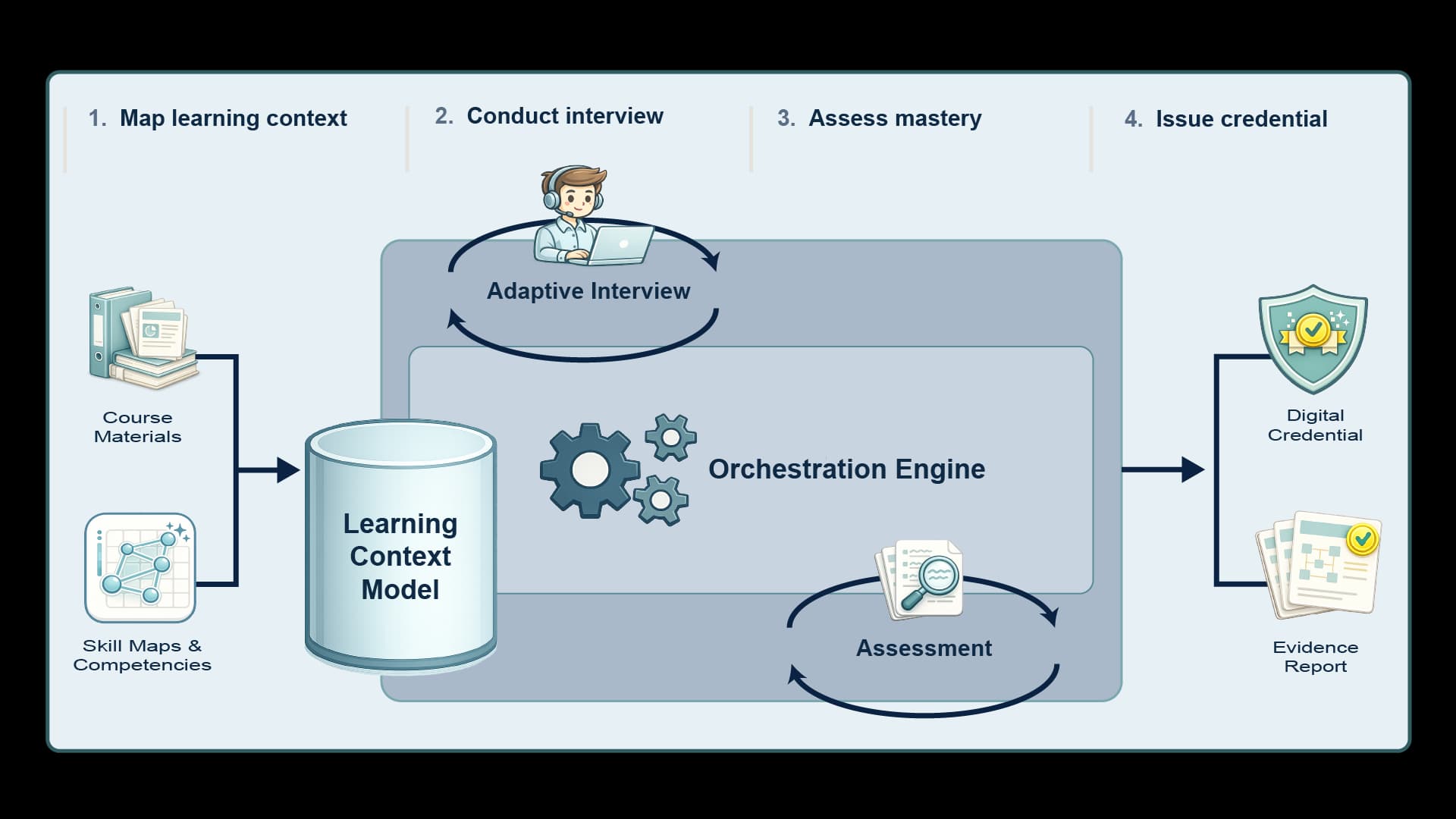
VeraCredentials leverages VeraLearning's Learning Context Model™ (LCM) to give AI the foundation it needs to recognize and evaluate mastery by:
Translating course materials and competencies into adaptive, dialog-based interviews
Probing reasoning and testing understanding through targeted questioning
Evaluating performance against defined criteria to build a structured evidence trail
Flexible by design
Built to fit your programs and standards.
VeraCredentials can be white-labeled and customized to fit your programs, standards, and learners. Our Learning Context Model™ (LCM) aligns with existing curricula and skill frameworks to ensure evaluation remains valid, consistent, and explainable.
Designed to support contexts such as:
Universities and academic programs assessing reasoning and understanding beyond static exams
Vocational and technical institutions validating job-ready skills
Workforce and employer-led programs assessing real-world readiness
What teams get
- Transparent mastery snapshots
Every adaptive interview produces a structured reasoning trail that shows how a learner approached the task, not just what they recalled. - Signals mapped to your needs
LCM™ ensures every question, probe, and score ties directly to the competencies and indicators you already use, keeping evaluation consistent and explainable. - Evidence you can hand off with confidence
Share concise reports with partner schools, employers, or certifying bodies without interpretation gaps or manual rewriting.
How VeraCredentials works
From course materials to competency-based evidence.
VeraCredentials aligns with your course materials and skill maps, operationalizes competencies, orchestrates adaptive interviews, and evaluates mastery to produce transparent evidence and verifiable credentials that reflect what learners can actually do.
Step 1
Map your learning context
VeraCredentials ingests course materials, job requirements, and skill frameworks to expose the cognitive demands and expectations that matter.
Step 2
Run AI-powered interviews
VeraCredentials conducts real-time interviews that seek evidence of mastery. Each turn of the conversation adjusts to the learner and stays aligned with the competencies and expectations that matter to you.
Step 3
Evaluate learner mastery
VeraCredentials analyzes learner responses against defined competencies and performance criteria. Evidence is scored, traced to standards, and synthesized into a clear picture of what the learner can reliably do.
Step 4
Issue verifiable credentials
VeraCredentials produces defensible decisions, evidence trails, and sharable mastery reports so every stakeholder understands why it’s a yes.
Use case · Applied Skills Assessment
How the learner reasoned through CNC operation tasks
VeraCredentials conducts applied skills assessments that capture how learners perform and reason through real workplace tasks. In technical domains such as CNC (Computer Numerical Control) machine operation, these assessments provide structured evidence that supplements test scores by showing how safety checks, task order, and decision-making are applied in practice.
In the assessment snapshot shown, the learner demonstrates a clear understanding of the purpose behind required safety steps and follows the primary operational sequence correctly. Gaps appear in consistency, including occasional missed confirmations, incomplete workspace checks, and rushed verification. With oversight or a structured checklist, the learner can operate safely; however, the evidence indicates they are not yet ready to run machines independently.
Based on this assessment, the learner receives a shareable, verifiable digital credential issued as an Open Badge 3.0 and aligned with W3C Verifiable Credentials. The credential is portable across platforms and links directly to a structured evidence record that documents demonstrated competencies, coverage across defined themes, and specific areas for improvement. Employers and training programs can review this evidence directly to support decisions about readiness, supervision, and next steps.
Assessment Snapshot
- Competency level
- Ready with support
- Mastery evidence
- 4 of 5 critical themes
- Interview length
- 16 minutes
- Export
- Structured evidence report
VeraLearning’s LCM™-based engine structures the interview, scores reasoning patterns, and outputs a defensible decision trail you can share directly with faculty and employers.
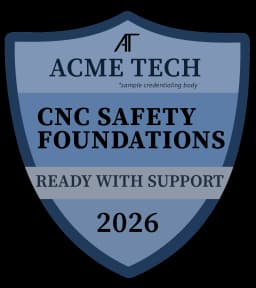
Issued badge · CNC Safety Foundations
Learners who meet the Assisted Readiness bar receive a shareable digital credential that makes verification effortless for employers.
Use case · Clinical Intake
How VeraLearning’s AI models structure reasoning in real-world contexts
VeraIntake, VeraLearning’s clinical intake product, applies the same reasoning framework used in applied skills assessment accross high-stakes, real-world conversations. Domain logic is encoded explicitly in system design, while AI is used to interpret and shape language—enabling information to be captured, organized, and evaluated against domain context as interactions unfold.
In medical intake, this means structuring patient-reported information using VeraLearning's Medical Context Model (MCM™), which defines what information matters, how elements relate, and which patterns signal risk or urgency. The system adapts dynamically—filling gaps when needed, preserving uncertainty when information cannot be confirmed, and surfacing clinically relevant signals in real time.
This approach enables VeraIntake to operate flexibly across engagement modes. The same models can listen to clinician-led encounters, assist with real-time prompts, or conduct an intake interview directly—while producing consistent, structured outputs. The result is a FHIR-compliant intake report that makes urgency visible early and supports reliable triage, handoff, and downstream action when front-door systems are under pressure.
Intake Snapshot
- Acuity signal
- Urgency flagged
- Chief concern
- Chest pain (~45 min)
- Red flags
- Crushing-like pain
- Radiation to left arm
- Export
- Structured intake report
VeraIntake uses its Medical Context Model (MCM™)—a domain-specific framework that defines what information matters, how elements relate, and which patterns signal clinical risk or urgency.
Intake report
VeraIntake delivers a structured clinical summary that accelerates triage and downstream action.